Product

    AI Receptionist for DSOs: Central Answering, Per-Office Booking

    Group phone problems are routing problems. Here is how to solve them without a central call centre.

    Wavez Team9 min read
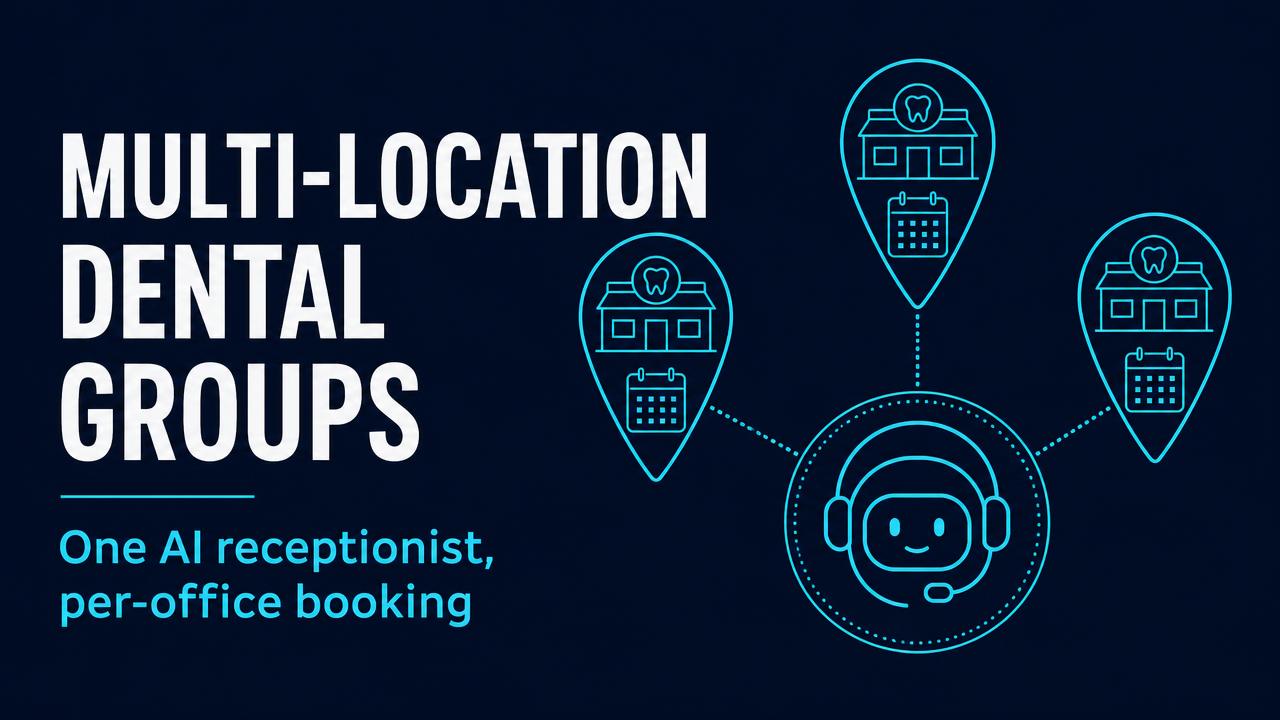
    Flat illustration of multiple clinic location pins connected to a single call hub

    Where multi-location groups actually lose calls

    A single-location practice has one failure mode: nobody picked up. A group has four, and only one of them is answering speed.

    • Wrong-office calls. The patient rings the number they found on Google, which is not the office they attend. The desk takes a message and hopes it travels.
    • Sibling capacity invisibility. Office A is booked three weeks out while Office B, eleven minutes away, has Thursday open. Nobody on the call can see that.
    • Uneven staffing. The busiest site has the same two people on the desk as the quietest one, so overflow concentrates exactly where volume is highest.
    • Reporting that stops at the group level. Regional managers see totals, not which office is dropping calls at 8am.

    A central human call centre solves the first two and creates a new problem: patients get a stranger who does not know the office. AI answering solves them without that trade-off, because it reads the actual schedule of the actual office rather than working from a script.

    Three routing models for groups

    Model 1 — Number-per-office

    Each location keeps its published number and rolls over to the same AI. The dialled number identifies the office, so the caller never has to state it. This is the cleanest model and the one most groups should start with, because it preserves local search listings exactly as they are.

    Model 2 — Single group number

    One number for the brand. The AI asks which location the caller wants, or infers it from the patient record when the phone number matches. Suits groups marketing at a regional level rather than per-practice, but it weakens local SEO signals if you retire the per-office numbers.

    Model 3 — Hybrid with regional escalation

    Per-office numbers into the AI, with human escalation routed to a regional coordinator rather than the local desk. This keeps clinical teams off the phone entirely and is common in larger DSOs with a shared services function.

    Cross-booking: the setting worth the most money

    When a caller wants an appointment this week and their usual office is full, the choice is between offering a sister location and losing the appointment. Groups consistently under-use this, usually because nobody has defined the rules.

    Define them explicitly, per location pair, before launch:

    1. Which locations may be offered as an alternative to which, and within what travel distance.
    2. Whether cross-booking is offered always, or only when the home office has nothing inside a defined window such as seven days.
    3. Whether new patients and existing patients are treated differently — many groups allow it freely for new patients only.
    4. Which appointment types are portable. Emergency and hygiene usually are; active treatment usually is not.
    5. How the home office is notified, so continuity of care and revenue attribution both stay clean.

    Attribution disputes kill cross-booking programmes faster than patient resistance does. Agree how the revenue is credited between offices before you switch it on.

    Integration realities for group platforms

    Cloud group platforms make this straightforward. Denticon exposes office IDs, so a single AI can read and write against each location independently and report per site. Curve Dental behaves similarly. Groups running server-based Dentrix or Eaglesoft across sites need a bridge per server, which is workable but lengthens rollout.

    The practical consequence is sequencing. Start the rollout with your cloud sites, prove the workflow, then take on the server locations with a longer setup window. See the PMS integration guide for how each platform behaves, or the Denticon integration page for group-specific detail.

    Reporting should be per office from day one. Group totals hide the exact problem you bought the system to fix — the one location dropping a fifth of its Monday calls.

    Group pricing is quoted per rollout rather than per office list price.

    Talk through a group rollout

    Frequently asked questions

    Yes. The AI identifies the intended office from the dialled number or by asking, then reads and writes against that office in the practice management system. Reporting and configuration stay separate per location.