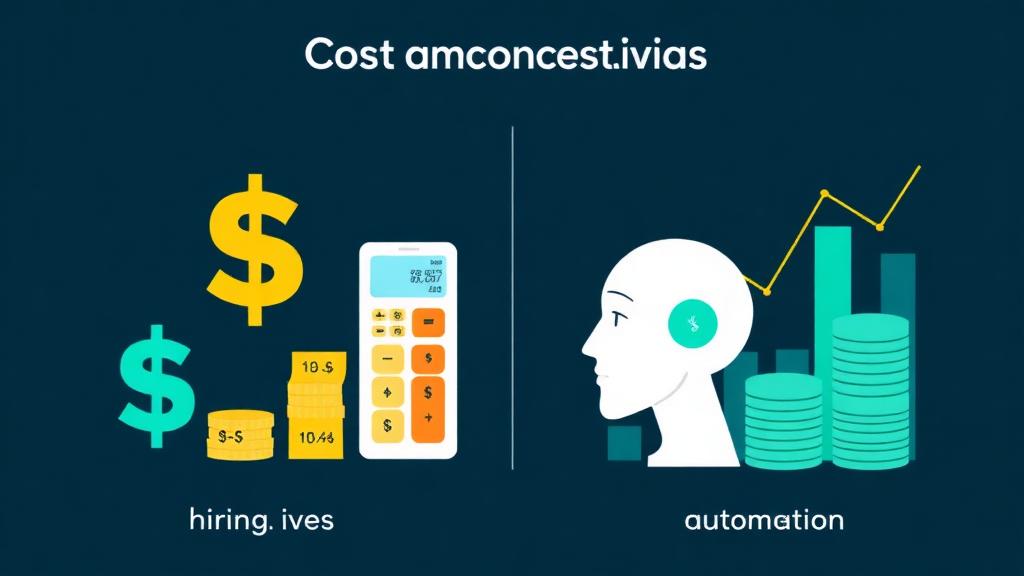
Cost of Hiring a Receptionist vs AI Automation
See the full cost of hiring a dental receptionist vs AI automation. Hard numbers, ROI, and when each makes sense.
Table of Contents
You’re not just paying a receptionist’s hourly wage. You’re paying for coverage gaps, missed calls, turnover, and after-hours silence. Here’s the real cost—and how AI changes the math.
Most dental and aesthetic clinics budget for salary and stop there. But the true cost of a front-desk hire includes recruiting, benefits, payroll taxes, training time, PTO coverage, and the silent killer: missed calls that never turn into new patients.
Meanwhile, patients don’t just call 9 to 5. They text, fill out forms, and call after hours. If your phones go to voicemail or your inbox fills up over the weekend, you’re losing revenue you already earned.
This isn’t about replacing people. It’s about matching tasks to the best tool. Humans shine at empathy in complex conversations and in-person experience. AI shines at availability, speed, and consistency. When you combine both, your throughput and ROI jump.
Below, we break down the cost of hiring a receptionist for a dental clinic, compare it to AI automation, and show where each wins. For background on how AI complements staff, see Blog 2 (AI vs Human). For the math on missed calls, see Blog 1 (Missed Calls). For guidance tailored to lean teams, see Blog 10 (Small Clinics).
The True Cost of a Dental Receptionist in the U.S.
Start with wage. According to the U.S. Bureau of Labor Statistics, the 2023 median annual pay for receptionists and information clerks is around $37,000 nationwide. In dental clinics and major metros, it often ranges $38,000–$50,000.
Now add typical load:
Conservatively, a $42,000 salary can easily land at $55,000–$65,000 fully loaded in year one, even before overtime, coverage, and systems costs.
The Hidden Costs Clinics Forget
[CTA] Book a Free Demo — wavezautomation.online/book-demo
What AI Automation Actually Replaces—and What It Doesn’t
AI is not a replacement for human empathy at the front desk. It is a replacement for:
Your team still handles in-person hospitality, complex clinical scheduling, and sensitive situations. AI shoulders the 24/7, high-speed, repetitive workload—and hands off complex cases with full context.
Cost Comparison: Year One
Scenario A: One full-time receptionist
Scenario B: AI Receptionist + Lean Front Desk
Even if you keep a smaller front-desk team, shifting routine tasks to automation typically saves $30,000–$40,000 in direct costs and more in recovered revenue.
The Revenue Side: Missed Calls and Faster Booking
Let’s quantify the upside using conservative assumptions:
If automation recovers even 30% of those 64 lost leads, that’s ~19 extra bookings/month.
That recovered revenue alone can 5–10x the annual AI subscription cost.
For more on the mechanics of missed calls and recovery math, see Blog 1 (Missed Calls).
[CTA] Book a Free Demo — wavezautomation.online/book-demo
Addressing Common Objections
Where Hiring Still Makes Sense
Even then, AI should handle intake, reminders, and after-hours inquiries. It multiplies your human team rather than replacing it.
Dental-Specific Cost Context
According to the ADA Health Policy Institute, staff costs are a major component of practice overhead, often in the mid-20% range of collections. Trimming nonclinical admin time with automation helps maintain margins without compromising care. In a climate of rising wages and payer pressure, protecting each phone call and form submission is a direct margin defense.
[CTA] Book a Free Demo — wavezautomation.online/book-demo
Real-World Case Study
Clinic: Riverbend Dental, Nashville, TN
Before:
After AI Receptionist (Wavez) + lean desk (90 days):
Why Most Clinics Fail at This
They underestimate the cost of inconsistency. It’s not just salary; it’s the variability of human coverage. Lunch breaks, busy check-ins, and time off all interrupt lead handling, and those interruptions compound.
They also misplace human talent. Highly capable coordinators spend hours on repetitive tasks—chasing forms, leaving voicemails, and confirming basic details—instead of elevating patient experience and case acceptance.
Reporting is another gap. Without measuring answer rates, time-to-first-response, and missed-call recovery, owners can’t see where revenue is leaking. What doesn’t get measured doesn’t get fixed.
Finally, many clinics frame this as “AI vs people.” It’s really “AI for speed and scale; people for empathy and complex judgment.” That shift unlocks both growth and staff sanity.
Wavez Automation gives you a 24/7 AI receptionist that:
No extra hiring. No overtime. Just consistent coverage and measurable ROI. For a balanced view of when to use AI vs staff, read Blog 2 (AI vs Human). If missed calls are your bottleneck, see Blog 1 (Missed Calls). Running lean? Check Blog 10 (Small Clinics).
Frequently Asked Questions
Q1: What’s the average salary for a dental receptionist?
A: BLS data puts the national median for receptionists around $37k, with dental front-desk roles in many markets ranging $38k–$50k before benefits and taxes.
Q2: How much do benefits add to the cost?
A: A common range is 15–25% of salary, plus 7.65% for employer payroll taxes. BLS ECEC data shows benefits average near 30% of total compensation across private industry.
Q3: Can AI really book directly without double-booking?
A: Yes. With calendar integration and hold rules, AI offers real-time availability and follows your double-booking buffers and provider preferences.
Q4: Will AI help with insurance and eligibility?
A: AI can gather necessary patient details, explain your coverage policies, and tee up eligibility checks for staff or supported integrations, cutting phone tag dramatically.
Q5: What about after-hours emergencies?
A: Configure triage rules. AI can share your emergency protocols, offer first-available slots, and escalate true emergencies per your policy.
Wavez Editorial
Wavez Automation Research Desk
Editorial byline reviewed by the Wavez founders before publication.
The Wavez Editorial byline covers research, buyer's-guide, and reference articles compiled by the Wavez Automation team. Every editorial piece is reviewed by co-founders Mirza Umaid Baig or Abdul Ghani Bin Ahmed before publication and cites vendor and government sources where possible.
View author profile →Related Articles

Ready to Transform Your Practice?
See how Wavez AI receptionist can help you capture more appointments, reduce missed calls, and grow your revenue—starting in just 48 hours.