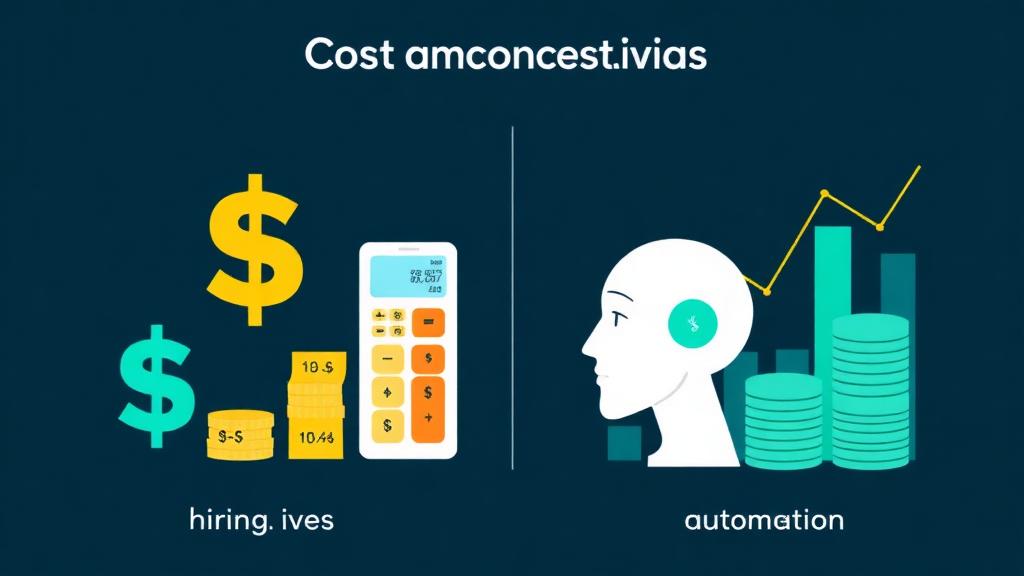
The Hidden Cost of Per-Minute Answering Services
Per-minute billing charges you most when your practice is busiest, and the deliverable is still a message rather than a booked appointment.
Table of Contents
Per-minute billing has an elegant logic to it: you pay for what you use. In a dental practice it produces a set of incentives that work against you at almost every point.
You pay most when you are busiest
Call volume in a dental practice is not flat. It spikes after a marketing campaign, during flu season, after a competitor closes, and every January when insurance benefits reset. Those are precisely the months when a per-minute service bills most.
The result is that the cost of answering the phone rises exactly when the practice most needs answering capacity, which produces the very natural but very expensive instinct to keep calls short.
Short calls are the wrong optimisation
A new-patient call that runs six minutes and ends in a booked appointment with insurance screened and forms sent is a good call. A two-minute call that ends with "we'll have someone call you back" is a bad one, and it costs a third as much.
Any billing model that rewards the second outcome is misaligned with the practice's economics. The gap between the two is easily a few hundred dollars of production, against a billing difference of perhaps four dollars.
The deliverable is usually still a message
The deeper problem is not the pricing model but the product. Most human answering services cannot see your appointment book. They take a name, a number and a reason, and your team works through the list the next morning.
By then the patient who called at eight in the evening has usually booked with somebody else. The service performed exactly what it promised and the practice still lost the patient.
What the real cost comparison looks like
A typical dental answering service runs somewhere between two hundred and six hundred dollars a month at low volume, with holiday and after-hours surcharges, escalating quickly as call minutes rise. A busy month can double it.
Flat-rate automated answering removes the variance. There is a single monthly figure regardless of whether the practice took three hundred calls or eight hundred, and nights, weekends and public holidays are inside that figure rather than surcharged.
For most single-location practices the flat figure lands close to the average month of a per-minute service — and materially below the busy months, which are the months that matter.
Questions worth asking any answering provider
Does the service write appointments into the practice management system, or take messages? What is the surcharge structure for holidays and overnight? What is the average answer time, measured rather than promised? Is there a per-call or per-minute component that varies? Who handles a caller the service cannot help, and how quickly?
The answers to those five questions predict the actual cost per booked appointment far better than the headline monthly rate.
Cost per booked appointment is the only figure that matters
Divide the monthly cost by the number of appointments that would not otherwise have been booked. A four-hundred-dollar service producing two recovered bookings has a cost per booking of two hundred dollars. A nine-hundred-dollar service producing twenty-five has a cost per booking of thirty-six.
The cheaper invoice is the more expensive service. This is the calculation most practices never run, and it is the one that changes decisions.
The honest limitation
Automated answering is not better at everything. A complex insurance dispute, an upset patient, or a nuanced clinical question is better handled by an experienced human, and any provider claiming otherwise is overselling. The right structure is automated first response for the ninety percent that is routine, with fast, clean escalation for the rest — and a billing model that does not penalise you for the calls that go long.
Mirza Umaid Baig
Co-Founder, Wavez Automation
Co-founder building AI phone infrastructure for US dental practices.
Mirza co-founded Wavez Automation to fix the single biggest revenue leak in independent dental practices: missed phone calls. He works directly with solo dentists and 1–5 location groups on voice-AI deployment, PMS integrations (Dentrix, Open Dental, Eaglesoft), and HIPAA-aligned call workflows.
View author profile →Related Articles

Ready to Transform Your Practice?
See how Wavez AI receptionist can help you capture more appointments, reduce missed calls, and grow your revenue—starting in just 48 hours.